The Professional AI Manifesto
The Decision Discipline in the Age of AI
Artificial Intelligence is changing how professional work is produced.
Reports can be generated instantly.
Research can be summarized in seconds.
Strategies can be suggested before the meeting even begins.
The speed is extraordinary.
But one thing has not changed.
Responsibility still belongs to Professionals.
The Accountability Gap
AI systems can generate information.
But they do not own the outcomes.
They do not carry professional reputations.
They do not answer difficult questions after mistakes.
They do not stand in front of clients, regulators, or leadership teams.
Professionals do.
As AI becomes embedded in everyday workflows, a gap is emerging between how work is generated and who remains accountable for decisions.
That gap cannot be ignored.
Technology Does Not Remove Responsibility
Every technological shift in history has changed how work is done.
But responsibility has always remained with people.
Pilots still own flight decisions despite automation.
Doctors remain accountable despite diagnostic tools.
Engineers remain responsible despite advanced modeling systems.
Artificial Intelligence is no different.
AI can assist Professional Work.
But it does not replace Professional Judgment.
A New Discipline Is Emerging
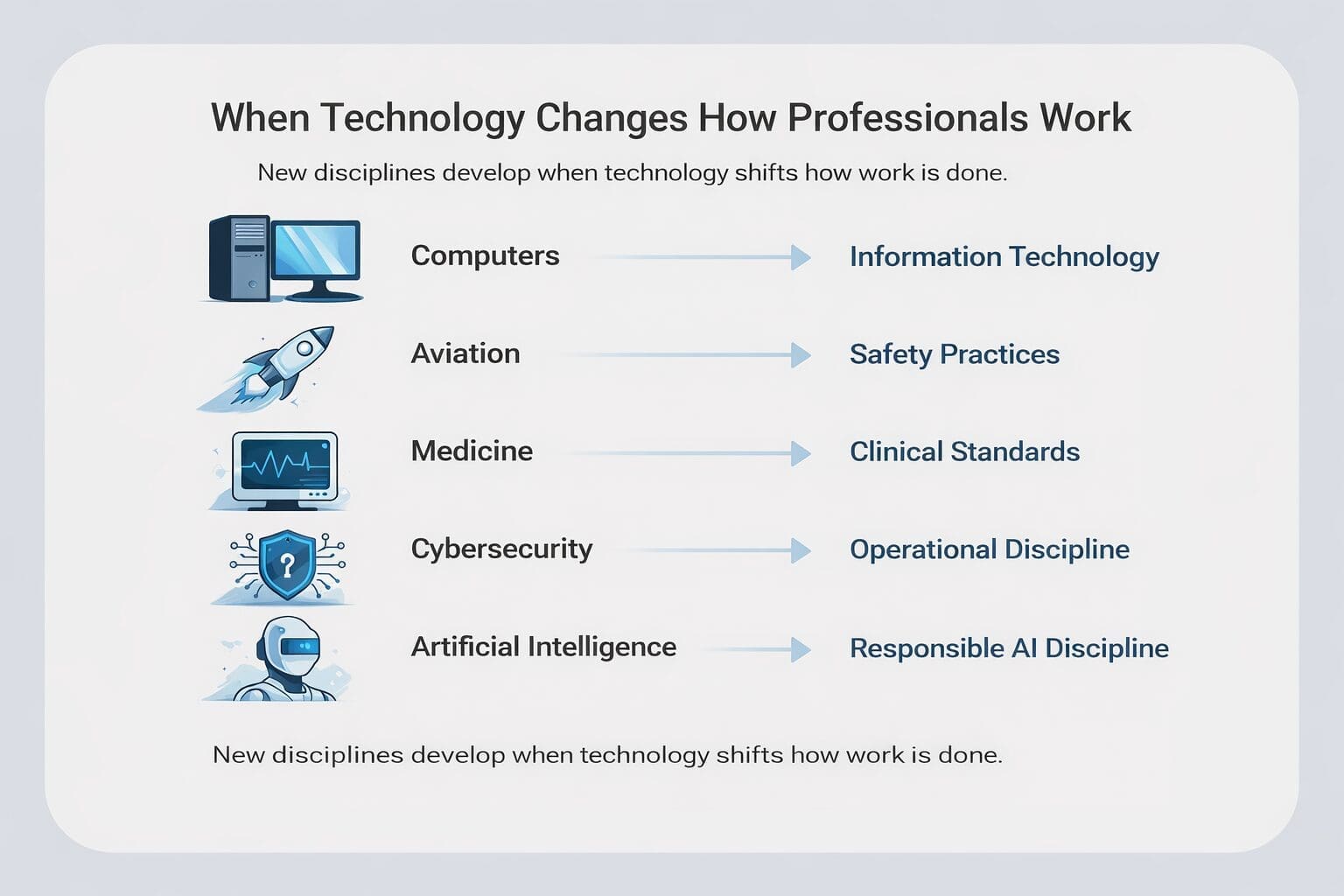
When technology changes professional environments, new disciplines eventually emerge.
Safety disciplines emerged in aviation.
Clinical disciplines emerged in medicine.
Operational disciplines emerged in cybersecurity.
Artificial Intelligence is now entering professional decision environments across industries.
Professionals need a similar level of clarity about how to maintain responsible judgment when AI becomes part of the process.
The challenge is not learning to use the AI tools.
The challenge is maintaining dependable decisions when those tools are present.
The Human Judgment Still Matters
Artificial Intelligence can generate remarkable outputs.
But professional work has never been defined by output alone.
Professional work requires:
Judgment
Responsibility
Accountability
Context
AI can assist many parts of the process.
But it cannot replace the responsibility professionals carry for the outcomes of their decisions.
The Professional Response
Professionals must approach AI with the same seriousness applied to any other powerful technology.
Not with Fear.
Not with Blind Trust.
But with Discipline.
Professionals must understand how AI influences their work, where decision authority remains, and how to maintain accountability in environments where AI-generated outputs are increasingly common.
This is not about resisting technology.
It is about using it Responsibly.
Why AIS Bootcamp Exists
AIS Bootcamp was created to help professionals navigate AI-assisted decision environments with clarity and discipline.
It focuses on a question that most AI training ignores:
How do professionals maintain dependable decision-making when AI becomes part of their workflow?
AIS Bootcamp provides structured guidance designed specifically for individual professionals whose names are attached to the decisions they make.
Because when AI-generated work becomes part of professional environments, the most important skill is not simply generating information.
It is knowing how to stand behind the decisions that follow.
The Future of Professional Work
Artificial Intelligence will continue to transform professional work.
Tools will become more powerful.
Outputs will become more sophisticated.
Workflows will continue to accelerate.
But one thing will remain constant.
Professionals will still be accountable for the decisions made within those systems.
Dependable decisions will matter more than ever.
The Principle
Artificial Intelligence can generate work.
Professionals still own the decision.
What Comes Next-Is The AI Manifesto
The Professional AI Manifesto explains why this moment matters.
AIS Bootcamp provides the guidance system professionals use to navigate it.
If your role involves making, approving, or communicating decisions, AI-assisted work is already changing your environment.
AIS Bootcamp exists to help professionals meet that challenge responsibly.